
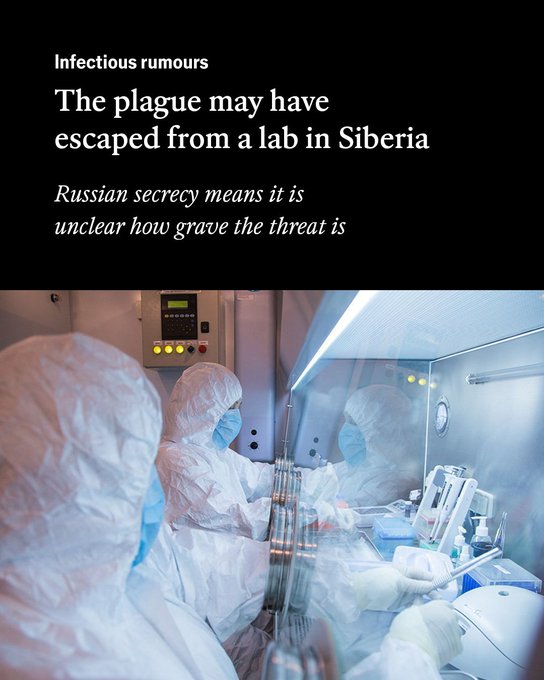
A fatal incident at a remote research facility in Siberia has sparked international concern, drawing renewed attention to Moscow's history of opacity surrounding biological safety and research.
The crisis began following the death of Darya Shipilova, a young technician working at the Irkutsk Anti-Plague Research Institute of Siberia and the Far East. Shipilova reportedly succumbed to severe pneumonia, prompting fears that she had mishandled a strain of pneumonic plague. The facility was subsequently placed under lockdown, while unverified reports indicated that Russian security services had taken up positions around the site and were escorting transport vehicles to local medical facilities.
Medical experts note that pneumonic plague, while exceptionally dangerous if untreated, is a known disease with a few hundred cases reported globally each year. It remains curable with standard antibiotics if diagnosed early. Paradoxically, the rapid lethality of the disease often restricts its spread, preventing infected individuals from transmitting the pathogen widely before incapacitation. Furthermore, the remote location of the Irkutsk institute provides a natural geographic buffer against potential community transmission.
Unanswered Questions and Global Concern
Despite these mitigating factors, the event has raised serious questions among international health experts and Western diplomats regarding the precise nature of the work being conducted in Irkutsk. Observers are questioning whether the facility was working with standard wild strains of the plague or experimenting with engineered, highly virulent variants. Questions also remain regarding why local authorities reportedly initiated quarantine measures affecting hundreds of residents.
In response to the growing uncertainty, a United States State Department spokesperson urged Russian officials to share accurate information quickly and transparently. However, official communications from Moscow have provided little clarity.
Primary oversight of the situation falls under Russia's Federal Service for the Oversight of Consumer Protection and Welfare, widely known as Rospotrebnadzor. Originally operating under the Ministry of Health, the agency was reorganized in 2012 to report directly to the central government, expanding its administrative mandate over epidemiological research and biological facilities.
Statements issued by Rospotrebnadzor have provided minimal details regarding the cause of death. The agency stated that no microorganisms associated with the employee's specific professional duties were detected in samples taken prior to her death, while officially classifying her demise as pneumonia of unknown cause. The statement left key parameters undefined, including the precise duties of the technician and the specific pathogen identified during post-mortem testing.
Official Silence and Escalating Protocols
Indications of a heightened official response emerged through regional channels. Igor Kobzev, the governor of the Irkutsk region, revealed on Telegram that Anna Popova, the head of Rospotrebnadzor, flew to the region to preside over an extraordinary meeting of the regional sanitary and anti-epidemic commission. According to reports, the emergency convening was prompted by a suspected case involving a particularly dangerous infection in a local resident.
When pressed for further information, Kremlin spokesperson Dmitry Peskov instructed the public to rely exclusively on official releases from Rospotrebnadzor and to ignore external speculation or reporting.
The deliberate ambiguity has led analysts to consider two distinct scenarios. The first involves a tragic containment failure during routine research aimed at developing public health protections against endemic plague strains, followed by standard state administrative silence. The second, more concerning possibility involves undisclosed research linked to defensive or offensive biological capabilities.
Former public health officials, including Dr. Ashish Jha, have pointed to Russia's historic engagement in complex biological programs as a reason for international vigilance. Observers also note that the Russian Ministry of Defense is currently undertaking expansion work at existing military facilities previously associated with biological research, while declining to comment publicly on the scope of the construction.
Historical Echoes of the Urals Cover-Up
The handling of the Irkutsk event closely mirrors historical precedents set during the Soviet era. The most prominent parallel occurred in the spring of 1979 in the city of Sverdlovsk, now Yekaterinburg.
Following an accidental release of anthrax spores from a military biological research facility, Soviet authorities mounted a systematic cover-up. Initial reports of a military and medical crisis leaked to émigré publications in West Germany, supported by high-level visits to the region by top defense officials. When Western governments raised concerns regarding potential violations of the 1972 Biological Weapons Convention—which Moscow had signed despite maintaining its programs—Soviet officials attributed the deaths strictly to the consumption of contaminated meat.
The official narrative of localized food poisoning was maintained for over a decade. It was not until 1992 that former Russian President Boris Yeltsin publicly acknowledged that the Sverdlovsk outbreak was caused by an accidental release from a bioweapons facility, noting that military officials had repeatedly lied to civilian leaders. The official recorded death toll stands at 68, though the total remains uncertain due to the immediate seizure and destruction of medical records by the KGB at the time.
As events continue to unfold in Siberia, international observers emphasize that state transparency remains the primary mechanism for mitigating global health risks and ensuring compliance with international safety protocols.







Post Comments