
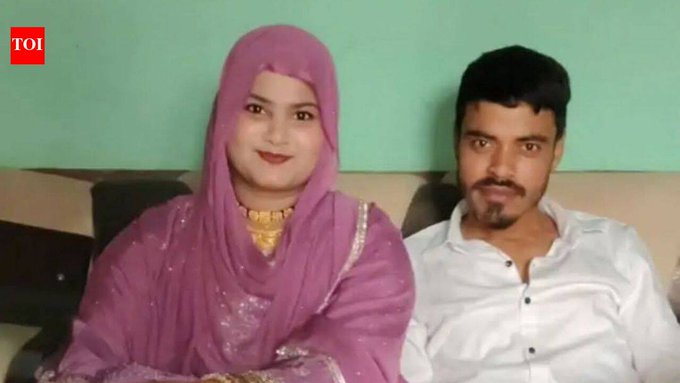
A chilling conspiracy has unraveled in the Lohia Nagar locality of Meerut, Uttar Pradesh, where a 27-year-old beautician and her lover allegedly murdered her husband and successfully passed off the crime as a sudden, fatal heart attack. The murder went unnoticed through the victim’s funeral, but a hidden mobile phone containing contentious text messages later exposed the illicit affair and prompted a full-scale police investigation.
The deceased, identified as 30-year-old Talib, had been married to Ilma for four years. The couple shared a three-year-old daughter and lived in Lohia Nagar, where Ilma worked professionally as a beautician. To family members and neighbors, the household appeared normal until late September, when a sudden tragedy set off a chain of events that eventually led to a grave exhumation.
A Deceptive Death and Swift Funeral
The incident occurred on the evening of September 28, when Talib returned home after completing his daily routine. Short hours after his arrival, Ilma contacted her brother-in-law, Akram, in a state of distress. She informed him that Talib had suddenly fallen ill upon coming home and had collapsed on his bed.
According to Ilma’s initial account to the family, Talib lost consciousness within minutes and succumbed to what she claimed was an unexpected cardiac arrest. Trusting her statement during a time of grief, the grieving family accepted the explanation without suspecting foul play. Consequently, no medical examination or police report was filed at the time, and Talib’s body was buried in accordance with traditional funeral rites shortly after his death.
The Hidden Phone and Conspiring Messages
Despite the burial, lingering doubts began to surface among Talib’s immediate relatives as irregularities in Ilma's behavior raised suspicions. On October 1, three days after the funeral, Talib’s relative, Raees, visited the residence to look into the circumstances surrounding the death.
During his visit, Raees noticed that Ilma was deliberately concealing Talib’s mobile phone. Searching the premises, Raees eventually discovered the device hidden beneath a pile of clothes. Upon inspecting the phone, he uncovered heated chat records exchanged between Talib and a man named Aman. The messages revealed that Talib had recently discovered an extra-marital affair between Ilma and Aman, and had explicitly warned Aman to stay away from his wife.
Confession Under Relentless Questioning
Confronted with the incriminating text exchanges by Talib’s family, Ilma was unable to maintain her cover story. Under intense questioning from the relatives, she confessed to planning and participating in the murder of her husband alongside her lover.
Ilma alleged that Talib frequently subjected her to physical abuse and that an altercation had occurred on September 28 after he returned home. Following the assault, she contacted Aman for assistance. Aman, accompanied by a friend, arrived at the house shortly thereafter. The three individuals physically assaulted Talib before Aman choked him to death using a chunni (scarf). According to Ilma, Aman had promised to marry her once her husband was permanently removed from the picture.
Legal Action and Body Exhumation
Following Ilma's confession, Talib’s family immediately approached the local police station and lodged an official complaint detailing the murder plot and the initial deception regarding the cause of death.
To proceed with a formal homicide case, law enforcement authorities required physical evidence. Police officials formally petitioned the District Magistrate for permission to exhume Talib’s body for a delayed post-mortem examination. Upon receiving administrative approval, officers and a team of medical experts exhumed the body from the graveyard on October 6.
Senior police officials confirmed that the remains have been sent for a thorough forensic autopsy to determine the precise cause of death and gather conclusive evidence against the accused. Authorities assured that strict legal action will be initiated against Ilma, Aman, and any accomplices involved as soon as the formal post-mortem findings are submitted.


Post Comments